
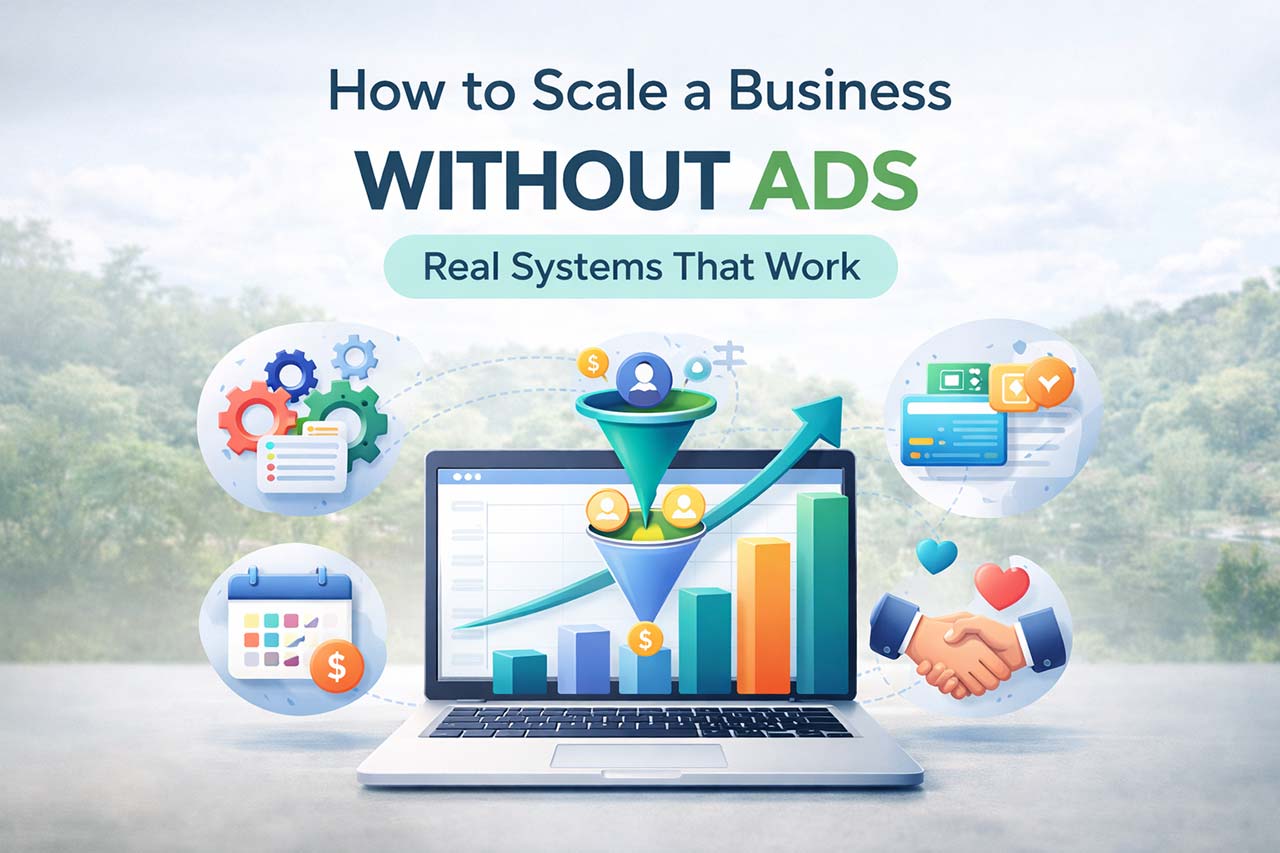
Why Paid Ads Don’t Create Sustainable Growth
Paid ads can generate immediate results, but they don’t build long-term momentum.
Every click has a cost. Every result depends on continuous spending. And the moment campaigns stop, growth slows down instantly.
This creates a fragile model where performance is tied to budget rather than structure.
In contrast, businesses that grow without ads focus on building systems that continue to generate results over time — without requiring constant financial input.
Why Most Businesses Struggle to Grow Without Ads
Most businesses rely on continuous actions to generate growth:
- publishing new content
- optimizing pages
- maintaining visibility
These actions can produce results, but each new result requires new work. Growth depends on constant effort, making it difficult to scale over time.
This is effort-based growth.
System-based growth takes a different approach.
Instead of relying only on continuous actions, it builds a structure where each effort strengthens a long-term system. The goal isn’t to eliminate work, but to ensure every action continues creating value long after it’s completed.
Owning Your Growth vs Renting It
One of the most important shifts in scaling a business without ads is moving from rented attention to owned growth.
When your business depends entirely on platforms, algorithms, or paid reach, you don’t control your visibility. Changes happen externally, and your results follow.
Owning your growth means building direct access to your audience.
It means creating channels, relationships, and systems that belong to your business — not to a third-party platform.
This is what makes growth more stable over time.
The 3 Core Systems Behind Scalable Growth
Businesses that scale consistently are not built around tools, but around structured processes. This approach creates a scalable model where each part of the business contributes to long-term, predictable growth.
Overview of the Core Systems Behind Scalable Growth
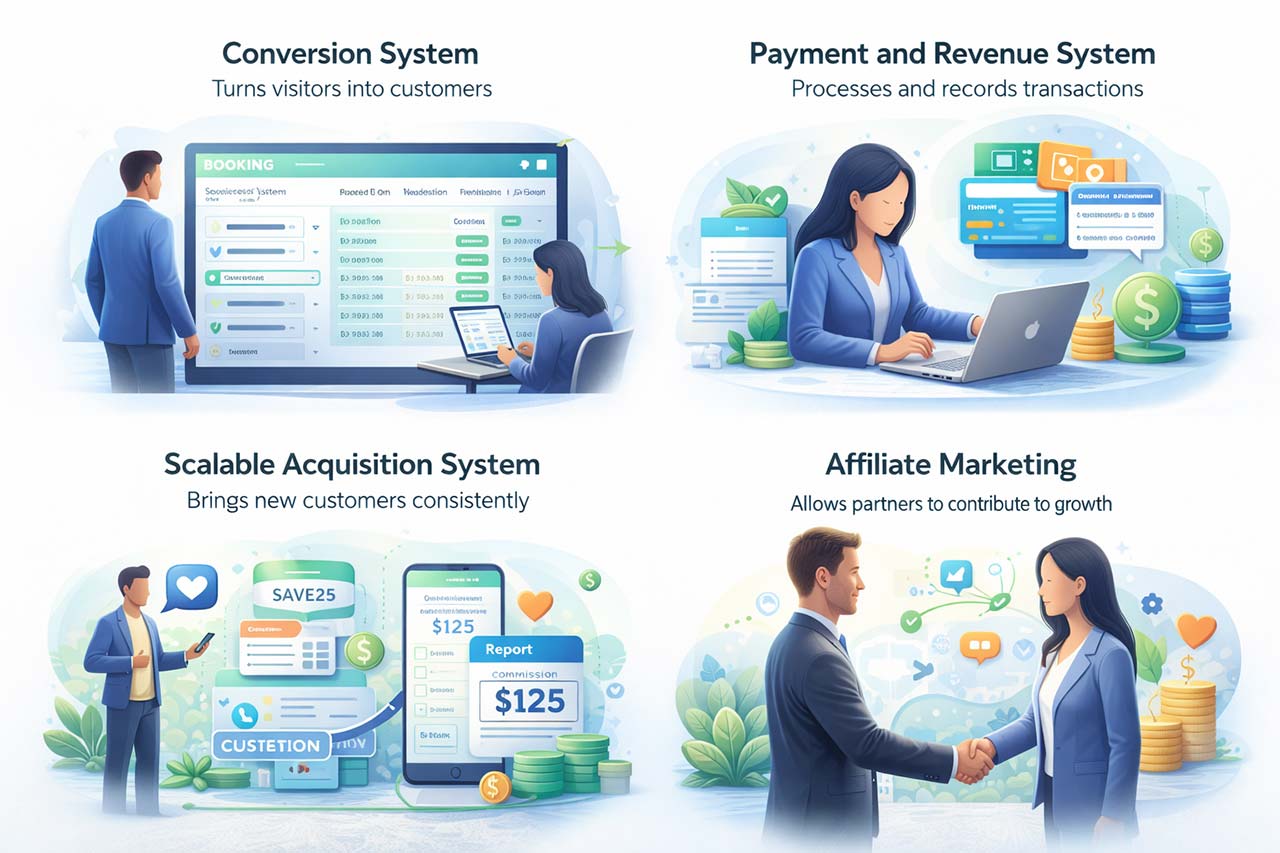
The three systems below form the foundation of a business that can scale without relying on ads.
| System | Purpose | What it handles |
|---|---|---|
| Customer conversion system | Turns visitors into customers | Services, availability, booking flow, pricing logic |
| Revenue and transaction system | Processes and records transactions | Checkout, taxes, deposits, invoices, order tracking |
| Customer acquisition system | Brings new customers consistently | Affiliate referrals, partner-driven traffic, commission tracking |
Each system plays a specific role, but their real impact comes from how they work together as a complete structure.
How to Scale a Business Without Ads (Step-by-Step)
Below is the practical framework to implement these systems in your business.
Step 1: Build a Conversion System
A conversion system defines how a visitor becomes a customer.
For example, service-based businesses using structured booking and payment systems can significantly reduce manual workload and increase conversion rates.
- a clear offer
- a structured flow
- a simple action (booking, purchase, signup)
Example
Instead of:
❌ “Contact us” pages
❌ manual email exchanges
Use:
✔ a structured booking system
✔ predefined services
✔ clear pricing
Real Implementation
Platforms like VOLIXTA approach booking as part of a complete business system — not just scheduling.
With a structured setup, you can:
- define services with precise durations and rules
- assign staff dynamically based on availability
- manage multiple locations from one system
- offer add-ons or packages directly in the booking flow
👉 Result:
- users don’t hesitate
- decisions are faster
- conversion becomes consistent
Step 2: Create a Revenue and Payment System
Once a user takes action, the transaction must be handled properly.
A payment system is not just about collecting money. It defines how revenue is structured, tracked, and managed.
With solutions like WooCommerce, businesses can:
- manage checkout flows
- apply taxes automatically
- support deposits or partial payments
- generate invoices and track orders
This connects user actions to a real financial system.
Instead of simply recording activity, the business operates through traceable transactions that can be analyzed and optimized over time.
👉 Result:
- no manual work
- no lost payments
- fully trackable revenue
Step 3: Build a Scalable Acquisition System
A business cannot scale without a consistent way to bring in new customers.
Most businesses rely on:
- SEO
- social media
- content marketing
These channels work — but they often require continuous effort.
To scale effectively, acquisition must become more repeatable and distributed.
Example: Affiliate-Based Acquisition
Instead of promoting your services alone:
- partners promote your business
- traffic comes from multiple sources
- commissions are paid only when results happen
Typical flow:
- partner shares a link
- user books a service
- system tracks referral
- commission is generated
👉 Result:
- scalable traffic
- no upfront ad cost
- growth beyond your own reach
How These 3 Systems Create a Growth Loop
When connected, these systems reinforce each other:
- Traffic →
- Conversion →
- Payment →
- Data →
- More optimized acquisition
This creates a loop where:
- each customer improves the system
- each improvement increases results
- growth compounds over time
Real Example: Scaling a Service Business Without Ads
Let’s take a simple case.
Before (manual growth)
- bookings handled manually
- payments separate
- acquisition depends on content
👉 Result: slow and inconsistent growth
After (system-based growth)
- booking system handles appointments
- payments are automated
- affiliate partners bring traffic
👉 Result:
- multiple clients handled at once
- predictable revenue
- scalable growth
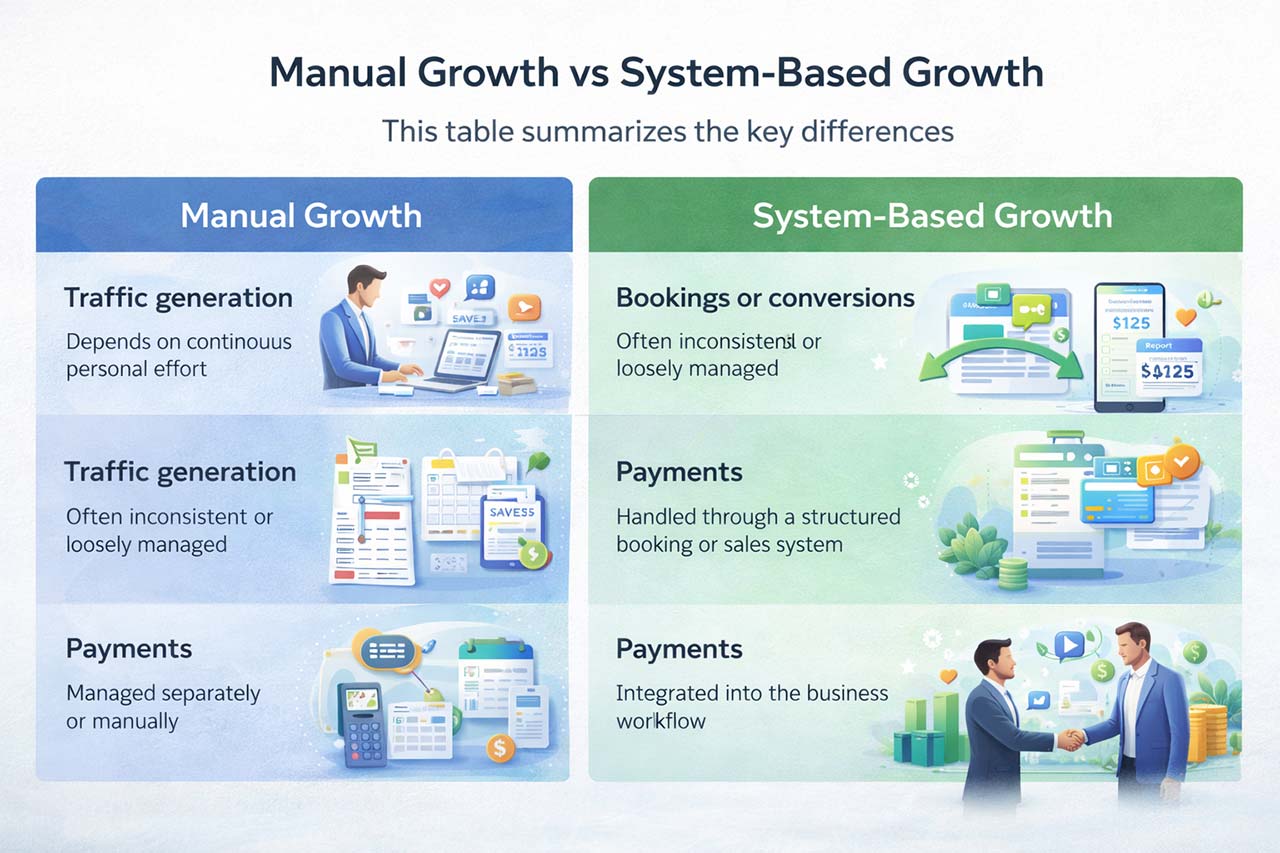
Manual Growth vs System-Based Growth
| Approach | Manual growth | System-based growth |
|---|---|---|
| Traffic generation | Depends on continuous personal effort | Can be supported by affiliate partners and repeatable channels |
| Bookings or conversions | Often inconsistent or loosely managed | Handled through a structured booking or sales system |
| Payments | Managed separately or manually | Integrated into the business workflow |
| Scalability | Limited by time and workload | More stable and repeatable over time |
Common Mistakes to Avoid
Most businesses fail because they:
- rely only on content
- don’t connect their systems
- manage payments manually
- depend on one traffic source
👉 Biggest mistake:
Trying to scale effort instead of building systems
How to Start (Practical Checklist)
Start simple:
Step 1
Map your current process:
- how users arrive
- how they convert
- how payments are handled
Step 2
Fix the biggest gap:
- unclear conversion
- manual payments
- weak acquisition
Step 3
Connect everything into one flow
👉 You don’t need everything at once — just start building the system.
Why Most Businesses Stay Stuck
Many businesses stay stuck because they focus on short-term actions instead of building long-term systems.
Without structure, results remain inconsistent.
Scaling a WordPress Booking Business
This is where structured tools and processes become essential.
This approach becomes especially relevant for businesses built around services or appointments.
WordPress provides a flexible environment where booking, payments, and acquisition can be connected into a single workflow.
For example, a typical setup can include:
- a booking system to handle appointments
- a payment system to manage transactions
- an affiliate layer to support acquisition
When these elements work together, the entire process becomes more efficient and easier to scale.
If your business relies on appointments or services, you can explore this detailed guide on how to scale a WordPress booking business without ads, where the entire system is applied step by step.
Choosing the right tools plays a key role in how efficiently this workflow operates. If you are still evaluating options, this overview of WordPress booking plugins and their use cases can help clarify which type of solution fits your business.
Key Takeaways
Scaling without ads is not about avoiding effort.
It’s about reducing dependency on manual processes.
A scalable business includes:
- a conversion system
- a revenue system
- an acquisition system
When these elements work together, growth becomes predictable and sustainable.
The Hard Truth About Scaling Without Ads
Scaling without ads is not an instant process.
It takes time to build structure. It takes consistency to see results. And it requires patience when growth feels slow at the beginning.
But what it builds is fundamentally different.
Instead of temporary spikes, you create stability. Instead of constant pressure, you develop momentum.
And over time, that becomes far more valuable than short-term gains.
Conclusion
Most businesses try to grow by doing more.
But that approach has limits.
Scaling a business without ads is not about doing less. It’s about building systems that continue to work — even when you stop.
FAQ About Scaling a Business Without Ads
What does it mean to scale a business without ads?
It means building a system that allows growth without relying on paid traffic, using structured conversion, automated payments, and scalable acquisition channels.
Can a business grow without paid advertising?
Yes, but it requires systems that reduce dependence on manual promotion and allow growth to happen more consistently.
Why do many businesses stop growing?
Growth often slows when it depends entirely on actions that require constant effort, such as content creation or outreach.
Is affiliate marketing necessary?
It is not required, but it is one of the most effective ways to create a scalable acquisition channel.
Does this apply to small businesses?
Yes. Small service-based businesses can implement these systems progressively and benefit from more stable growth over time.
How long does it take to scale without ads?
Results usually take longer at the beginning, but they tend to become more stable over time as systems start to produce consistent outcomes.
What is the biggest mistake when trying to grow without ads?
Focusing only on short-term actions instead of building a structure that supports long-term growth.
Can this approach work without a large audience?
Yes. What matters is not the size of the audience, but how effectively it is connected to a system that converts and retains customers.