
Why Businesses Start Looking for a Calendly Alternative
Calendly works well for straightforward scheduling. However, it was never designed to support complex business operations.
As companies grow, they often encounter limitations such as:
- restricted availability rules for staff and services
- limited support for multi-staff and multi-location setups
- payments treated as optional add-ons rather than core logic
- no professional invoicing adapted to real services
- increasing subscription costs as usage scales
- limited ownership over data and workflows
At that point, scheduling becomes fragmented, forcing businesses to rely on multiple disconnected tools.
What Calendly Does Well — and Where It Stops
Calendly excels at:
- fast setup
- clean user experience
- individual or small-team scheduling
But its design philosophy is intentionally simple. It does not aim to manage advanced booking logic, detailed billing, or service-based workflows.
For growing businesses, simplicity often becomes a constraint rather than an advantage.
What Growing Businesses Actually Need from a Booking Platform
A true Calendly alternative is not just another scheduling tool. It must support the entire booking lifecycle, from availability to invoicing.
Growing businesses typically need:
Advanced Scheduling Logic
Availability rules based on services, staff, locations, buffers, preparation times, and exceptions — not just open hours.
Multi-Staff and Multi-Location Control
The ability to manage teams, branches, and services without duplicating configurations or losing visibility.
Payments Integrated into Booking Logic
Deposits, partial payments, prepaid packages, and credits should be native features, not workarounds.
Professional Invoicing and Tax Calculation
Invoices must reflect real services, packages, add-ons, and tax rules — not generic product lines.
Data Ownership and Customization
Full control over customer data, workflows, branding, and long-term costs.
Why WordPress Is a Strong Calendly Alternative
WordPress offers something SaaS platforms cannot: full ownership and extensibility.
A WordPress-based booking system allows businesses to:
- host their data on their own infrastructure
- customize workflows without artificial limits
- integrate deeply with existing websites and e-commerce
- avoid dependency on recurring SaaS pricing models
When done correctly, WordPress can deliver a SaaS-level experience without SaaS constraints.
VOLIXTA Booking Plugin: A Calendly Alternative Built for Real Businesses
VOLIXTA is designed for companies that outgrow basic scheduling tools and need a complete booking platform inside WordPress.
Rather than replicating simple appointment booking, it focuses on operational depth.
Scheduling Designed for Scale
Services, staff schedules, preparation times, buffers, and exceptions are handled with precision — even across multiple locations.
Client and Staff Portals
Both customers and employees interact through dedicated front-end dashboards, reducing friction and eliminating backend access.
Packages, Add-Ons, and Credits
Businesses can sell bundled services, prepaid sessions, flexible add-ons, and gift credits with defined rules and expiration logic.
Beyond Payments: Replacing Standard WooCommerce Invoices
One of the major differences between VOLIXTA plugin and typical Calendly alternatives lies in billing.
Instead of relying on generic WooCommerce invoices, VOLIXTA uses custom booking-aware invoices that:
- reflect real services and packages
- calculate taxes accurately per service and add-on
- support deposits, remaining balances, and credits
- align invoices with actual appointment logic
Billing becomes a native part of the booking workflow, not an external layer.
Deep WooCommerce Integration Without the Usual Limitations
VOLIXTA integrates fully with WooCommerce while adapting it to booking-specific needs:
- custom cart pages designed for appointments
- custom checkout flows aligned with booking logic
- custom thank-you pages showing booking details
- full compatibility with WooCommerce payment gateways
- consistent synchronization between orders, bookings, and invoices
This approach combines WooCommerce’s payment ecosystem with a booking-first architecture.
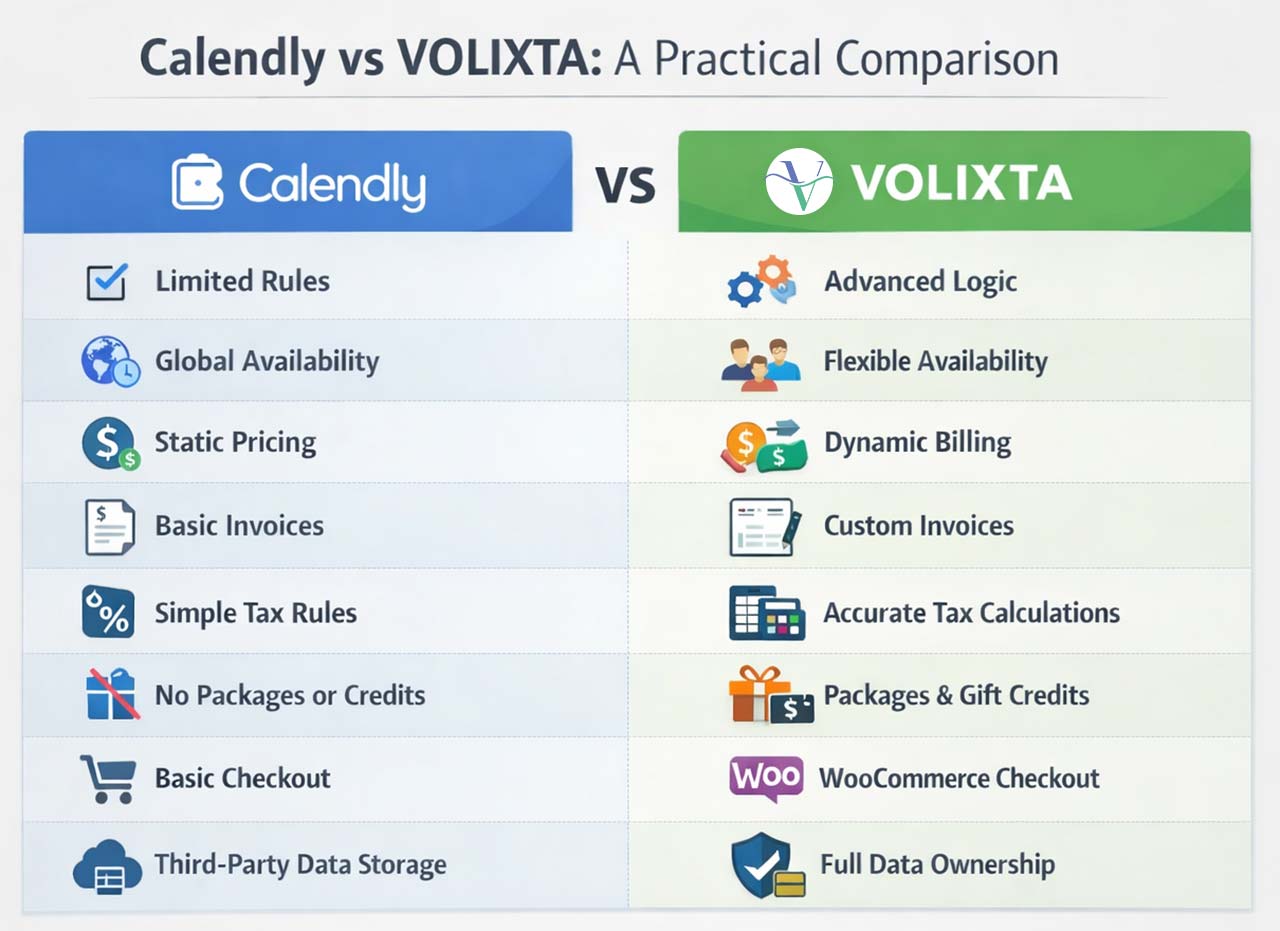
Calendly vs VOLIXTA: A Practical Comparison
| Feature | Typical SaaS Booking Platforms | VOLIXTA Plugin (WordPress-Based) |
|---|---|---|
| Scheduling logic | Limited rules with predefined constraints | Advanced logic linked to services, staff, locations, buffers, and packages |
| Availability management | Global availability with few exceptions | Per-service, per-staff, and per-location availability with custom rules |
| Billing flexibility | Static pricing with minimal adaptability | Dynamic billing based on services, add-ons, packages, deposits, and credits |
| Invoices | Generic invoices disconnected from booking logic | Custom booking-aware invoices generated automatically |
| Tax calculation | Basic or fixed tax rules | Accurate tax calculations derived from real service configuration |
| Packages & credits | Rarely supported or requires workarounds | Native package and credit system with limits and expiration rules |
| WooCommerce checkout | Standard checkout with no booking awareness | Custom checkout fully synchronized with booking data and availability |
| Cart & payment flow | Product-based and detached from scheduling | Booking-first cart flow designed specifically for appointments |
| Guest checkout & account handling | Basic or inconsistent experience | Secure guest checkout with optional account creation |
| Calendar integration | Manual exports or limited synchronization | One-click sync with Google, Apple, and Outlook calendars |
| WooCommerce integration | External or superficial integration | Deep, native integration with WooCommerce orders and payments |
| Scalability for teams | Becomes complex as teams grow | Built for multi-staff and multi-location organizations |
| Data ownership | Stored on third-party platforms | Fully owned and managed within WordPress |
Who Should Switch from Calendly?
A WordPress-based Calendly alternative is ideal for:
- growing service businesses
- teams managing multiple staff members
- companies operating across multiple locations
- businesses requiring accurate invoicing and tax handling
- agencies delivering booking systems to clients
If scheduling is a core operational process rather than a convenience feature, a more robust platform becomes essential.
Thinking About Switching from Calendly?
If you’re already considering a move away from Calendly, the next step is planning your transition carefully.
We’ve created a practical step-by-step guide that explains how to migrate without losing bookings, payments, or client data:
👉 How to Migrate from Calendly to WordPress Booking: A Practical Step-by-Step Guide
It covers data export, setup, testing, and a smooth transition strategy.
Conclusion
Calendly is an excellent scheduling tool — for simple use cases.
But growing businesses need more than availability links.
A WordPress-based solution like VOLIXTA offers the structure of a booking SaaS, combined with the flexibility, ownership, and billing depth that professional operations require.
For businesses ready to move beyond basic scheduling, a Calendly alternative built for WordPress is not just an option — it’s a strategic upgrade.